

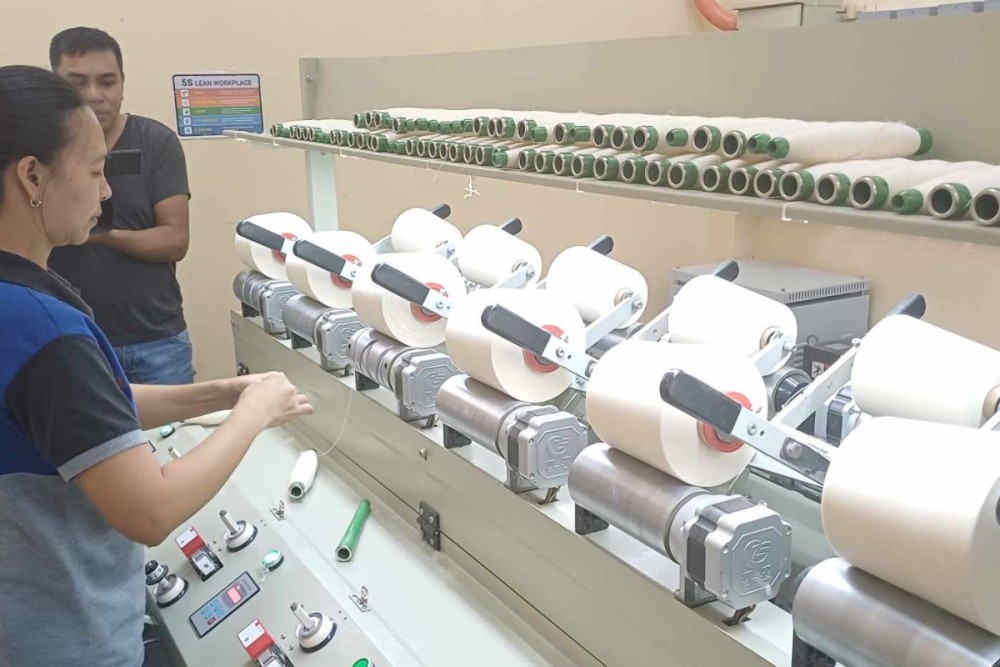
Bamboo is gradually gaining ground in the Philippines as a raw material for textiles, with Cagayan Valley (Region 2) and Abra pushing initiatives for that.
In 2022, the Department of Science and Technology (DOST), the Philippine Textile Research Institute (PTRI), and the Isabela State University (ISU) collaborated to implement the bamboo textile development project in the Cagayan Valley. PTRI is an agency under the DOST.
In Abra, the newly opened Bamboo Fiber Textile Innovation Hub at the University of Abra (UA) Main Campus in Lagangilang, is getting farmers and entrepreneurs interested in producing fiber that can be used to make clothes, bags, accessories, and shoes. UA’s bamboo initiative is also supported by DOST and PTRI.
Jenelie Caya of the PTRI said that bamboo has a 35 percent fiber recovery rate, which is higher compared to the 1 to 2 percent fiber material recovery rate of pineapple leaves and banana pseudo-stem.
“Bamboo is a very rich source of textile material and it can give us a high value addition. For our bamboo fiber is at P250 per kilo. Treated fiber and opened version reaches P1,000,” she said.
DOST Region 2 Director Virginia Bilgera said the first phase of the project for Cagayan Valley was the establishment of a Bamboo Textile Fiber Innovation Hub at the ISU Cauayan City campus, which aims to extract and process natural fiber from bamboo poles.
"We chose Cauayan City as the host for the fiber production area because there's an abundant raw material in the city and the city government also vowed to support the project by encouraging all barangays to plant bamboo to sustain the supply of raw materials," Bilgera said.
Engr. Jerome Juan, project coordinator of the hub, said fiber extraction undergoes several processes from cutting, softening, degumming, bleaching, drying, and grinding.
"Based on our study, we can extract up to 40 percent fiber from 'kawayang tinik' that is why we advocate planting more of this bamboo species and likewise the giant bamboo," Juan said.
After the extraction, the produced fibers are brought to ISU Ilagan City to be processed into yarn at the Regional Yarn Production and Innovation Center for Northern Luzon. The facility was also funded by PTRI.
In the facility, the bamboo fiber is mixed with cotton to produce yarn, which is also a material used in producing fabric. The facility has been producing bamboo yarns ready for the market.
Bilgera said they have also tried producing clothes out of bamboo yarns. Samples of uniquely designed fashion clothes out of bamboo textiles were included in the fashion show conducted by DOST last year along with clothing made out of other natural textiles from other regions.
She also said that based on the analysis of other partner government institutions and private agencies, the bamboo textile produced in Region 2 has potential for the international market.
"However, our focus as of this time is to produce more fiber and yarn to develop and establish our textile industry in the region. What we are looking for as the next step of this project is to have also our weaving facility to complete the process into a fabric," Bilgera said.
On the part of ISU Ilagan, Dr. Alfonso Simon, campus executive officer, said they proposed for the establishment of a weaving facility, for both handloom and mechanical weaving.
"We want to complete the process of our textile industry in the region. We will be weaving our fabric. Through this, we can also develop our own identity in clothing," Simon said.
Dr. Freddie Orperia, professor, also said the textile industry can create more job opportunities, especially for unemployed women, and will spur more business enterprises in the region.
The yarn production facility is also part of Ilagan City's tourism circuit, offering an actual demonstration of how fiber turns into yarn.
Abra seeking ‘bamboo capital’ tag
For its part, Abra is seeking to become the “bamboo capital” of the Cordillera region.
“We recognize the significance of bamboo as an emerging high-value commodity here in the Cordillera, and its abundance in Abra, originally used for structural purposes and furniture making. Bamboo is now expanding to textiles,” said DOST Cordillera Director Nancy Bantog
PTRI Director Julius Leaño Jr. said the agency is pushing for farmer participation in fiber production through ensuring access to the facility and equipping farmers with skills and knowledge to protect themselves.
Aside from production, Leaño also ensured the beneficiaries of an available market for their bamboo fiber products. He said that PTRI will be the first to buy their fiber production to be used in making uniforms for at least 1.9 million government employees. This, he said, is in compliance with Republic Act No. 9242, or An Act prescribing the use of the Philippine tropical fabrics for uniforms of public officials and employees.
“This is capacity building to make our communities be more innovative, enterprising, and at the same time, take advantage of the vast resources that we have in the province,” he added.
Meanwhile, UA President Gregorio Turqueza said making Abra an epicenter for the manufacture of bamboo products will help uplift the lives of stakeholders and improve the province’s economy.
Turqueza also said the university has plans to establish a nursery for bamboo to ensure the production of bamboo raw materials that can be processed in the hub.
The university is also collaborating with the Department of Environment and Natural Resources for bamboo seedlings, and the Department of Trade and Industry for the marketing of bamboo products.
The Abra provincial government and the local government of Lagangilang also support the initiative that will not only bring better profit for farmers, but will also maximize the use of bamboo, a major product that has become part of the life and culture of Abrenians.
