

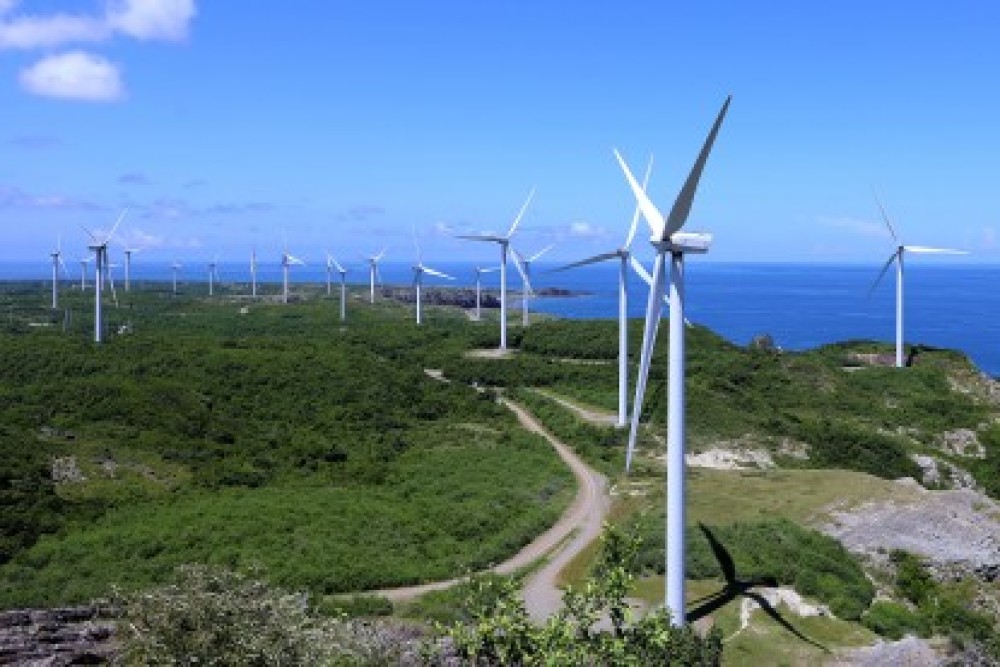
Efforts to ensure access to clean and sustainable power gained momentum this year as the Department of Energy (DOE) rolled out programs aimed at attracting greater investment in renewable energy (RE).
Renewables now account for about 32 percent of the country’s total energy mix, putting it close to the 35 percent target set for 2030. The DOE aims to further raise this share to 50 percent by 2040.
The agency earlier reported that approximately 956 megawatts (MW) of new power generation capacity had been added to the national grid as of last November, supported by an additional 16 MW of new energy storage capacity in the Luzon and Visayas grids.
In June, the DOE issued Notices of Award (NOA) to winning bidders under the third Green Energy Auction (GEA-3), which are expected to deliver around 6,600 MW of capacity through 2035. Winners of the fourth auction, GEA-4, were announced last November, with projects projected to generate more than 10,000 MW of new capacity by 2029.
Energy Secretary Sharon Garin expressed confidence that the country’s RE capacity will continue to expand following the two green energy auctions conducted this year, despite the termination of eight RE service contracts due to proponents’ failure to meet delivery timelines or submit required work programs.
Referring to initiatives implemented during the tenure of former Energy Secretary Rafael Lotilla—now serving as Secretary of Environment and Natural Resources—Garin said the DOE “started with good foundations already, and continuing that, you cannot go wrong.”
She noted that large parts of the country were hit by severe calamities this year, adding that lessons learned from these events will further strengthen preparedness and response efforts next year.
“My basic gauge is the quick response of the DOE in typhoon-affected areas. Before, in places like Masbate or Catanduanes, restoration could take six months. Now, in barely one month, we’re able to complete the work,” she said.
Garin attributed this improvement to stronger coordination among energy-sector stakeholders, including the National Electrification Administration (NEA), the Philippine Rural Electric Cooperatives Association (Philreca), distribution utilities, power plant operators, the National Power Corporation (Napocor), the Power Sector Assets and Liabilities Management Corporation (PSALM), and the National Grid Corporation of the Philippines (NGCP).
She added that the Energy Regulatory Commission (ERC) also plays a crucial role in advancing improvements in the domestic energy sector.
“The results this year are good. I’m quite proud of the DOE. We’ve introduced many innovations and responded to the President’s directives,” she said.
Looking ahead to 2026, Garin said priorities will center on “cleaner energy and energy security.”
“Hopefully, we can reduce our reliance on coal, especially diesel, particularly in the islands where renewables account for only about 7 percent,” she said. “We just need to strike the right balance.”
She also said more indigenous energy sources would be explored, underscoring the need to tap additional gas and petroleum potential.
“The Philippines has a lot of potential, and I know it will take years. But at least we’re starting now so we won’t be dependent on the international market,” she added.
