

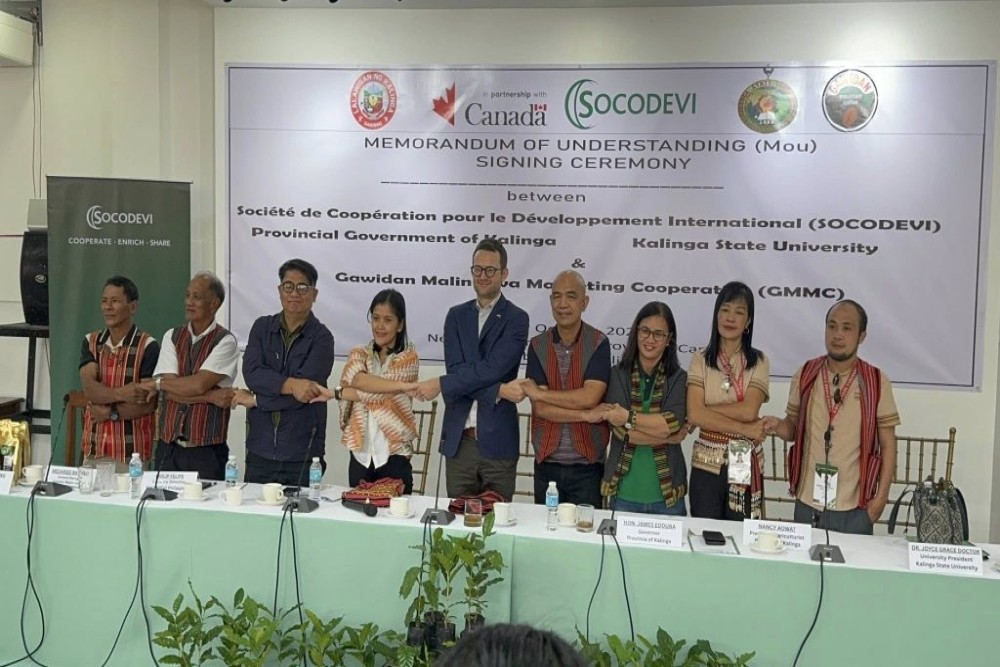
TABUK CITY, Kalinga — The Kalinga provincial government has partnered with Canada-based Société de coopération pour le développement international (SOCODEVI) to improve the coffee value chain in the province and make the sector climate-resilient and inclusive.
Together with Kalinga State University and the Gawidan Mallin-awaan Marketing Cooperative, they will collaborate on the Agsama Kape Project, a six-year strategic initiative supported by the Government of Canada through the Global Affairs Canada. This seeks to benefit an estimated 20,000 direct beneficiaries and 150,000 indirect beneficiaries in the Cordillera region and in the province of Nueva Vizcaya.
“We want to strengthen the coffee value chain. ‘Together for coffee’ ang ibig sabihin ng Agsama Kape. We really want to maximize the resources locally, from the local government unit, the evidence-based research from the Kalinga State University, and apply these to the coffee cluster in Kalinga, and hopefully, we can better the coffee value chain — from production to marketing,” said Philip Felipe, country director of SOCODEVI Philippines.
“It aims to diversify your incomes. It will result in sustainable impacts. It means you’ll be able to produce coffee, and most importantly, sell high quality coffee at high prices despite climate change and despite other challenges,” affirmed Simon Snoxell, Head of Cooperation of the Embassy of Canada to the Philippines.
Kalinga is the first province to sign on for the collaborative project, formalized through a signing of a memorandum of understanding and memorandum of agreement on Oct. 7, 2025 at the Provincial Capitol.
Governor James S. Edduba welcomed the assistance and expressed his administration’s commitment to revitalizing Kalinga’s coffee industry, citing the various farm-to-market roads successfully implemented in the province through the Philippine Rural Development Project to support coffee production.
“This partnership marks a significant step forward in realizing our vision for a stronger, more sustainable coffee industry,” Edduba said.
