

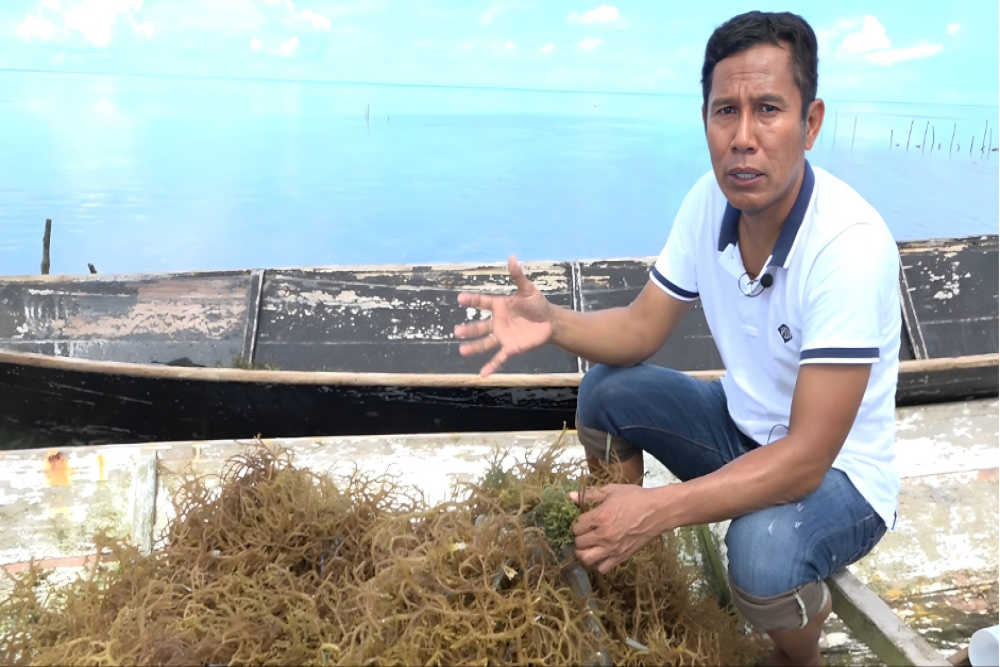
Seaweeds can provide an alternative and lucrative source of livelihood for fisherfolk and coastal communities, as the Philippines was once the top exporter of the commodity.
And for Agriculture Secretary Francisco Tiu Laurel Jr., the country has the potential to regain its top spot in terms of seaweed exportation globally, just like in the 1990s.
“Indonesia already surpassed our production…(but) we still have (an) unutilized area of 85,000 hectares. Until we reach that, we shouldn’t stop. If possible, we should accelerate the industry’s area expansion,” he said.
Indonesia currently produces five times more seaweeds than the Philippines.
Laurel said local harvest could generate as much as P550 million per 10,000 tons of dried seaweed each year. Local farmers can generate 70,000 metric tons of seaweed annually.
In 2022, the country generated $350 million or around $19.6 billion worth of export earnings from seaweed, much higher than the pandemic export sales of $250 million or P13.99 billion.
Laurel sees the problems affecting the local seaweed industry such as lack of seedlings, logistical issues, and high power cost, among others.
The country's seaweed processing facilities are also in Cebu and Manila even though most production comes from Mindanao.
To resolve these, Laurel said the industry must be supported with bigger tissue culture laboratories, provision of training to more technicians, and securing additional ports and power plants in the country.
He said there is also the need to drop logistics costs.
“There are a lot of dry containers in Zamboanga. I think we can solve the logistics issue there if we coordinate with other industries. It’s a matter of convergence,” Laurel said.
For his part, Mindanao State University Tawi-Tawi Director for Research Dr. Sitti Zayda Halun said that there is a need for additional investment in power and energy so seaweed processing plants can be established.
“Before, we were number one in seaweed production in the world, but we are now exceeded by Indonesia. Having processing plants, at least we could produce seaweed chips, which the food industry can use,” Halun added.
Providing renewable energy to the seaweed industry is also one good measure to sustain the sector.
One good example is the initiative of the Mindanao Development Authority (MinDA) that facilitated the Renewable Energy Technology for Seaweed Value-Added in Tawi-Tawi or RETS Project aiming to benefit 3,500 seaweed farming families in that part of Mindanao.
Funded by the European Union (EU) through its Access to Sustainable Energy Programme (EU-ASEP), and implemented jointly by MinDA and the United Nations Industrial Development Organization (UNIDO), the RETS project aims to generate a total combined capacity of 1.650 megawatts for the two island municipalities, through two hybrid solar-diesel power plants with an integrated battery energy storage system (BESS).
“The solar project can truly help us seaweed farmers, especially during rainy season when we cannot dry our harvests,” said Jay Abdu Razid, also a seaweed farmer in Sitangkai.
In addition, the ultimate goal is for homes and remote areas in the islands to be powered 24/7, so children could study well at night, and seaweed farmers will have improved productivity that will help boost the country’s seaweed industry.
